Underwrite
Offering memorandum in, lender package out. Fifteen modules over one deterministic engine, every value traced to its source page.

For hotel owners, operators and their lenders
Hotel underwriting in about ten minutes, and it is still there at disposition.
You upload the offering memorandum, and PATL reads it, sizes the loan against DSCR, debt yield and LTV, builds the USALI proforma, and hands back a live Excel model alongside a lender or investor package. The run persists: the broker package, the credit memo and the variance report are views of it rather than copies of it.





Where we underwrote before · not an endorsement
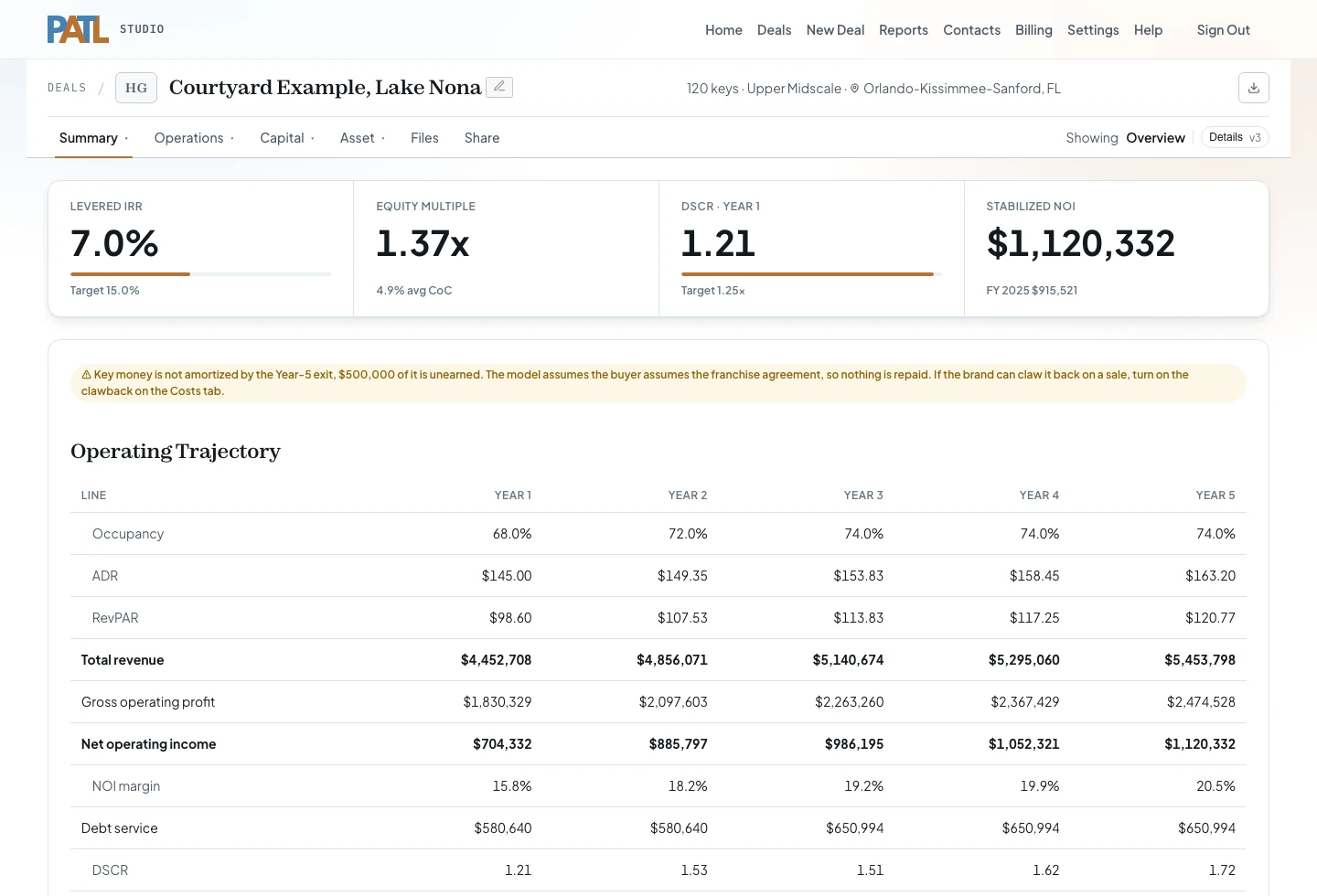
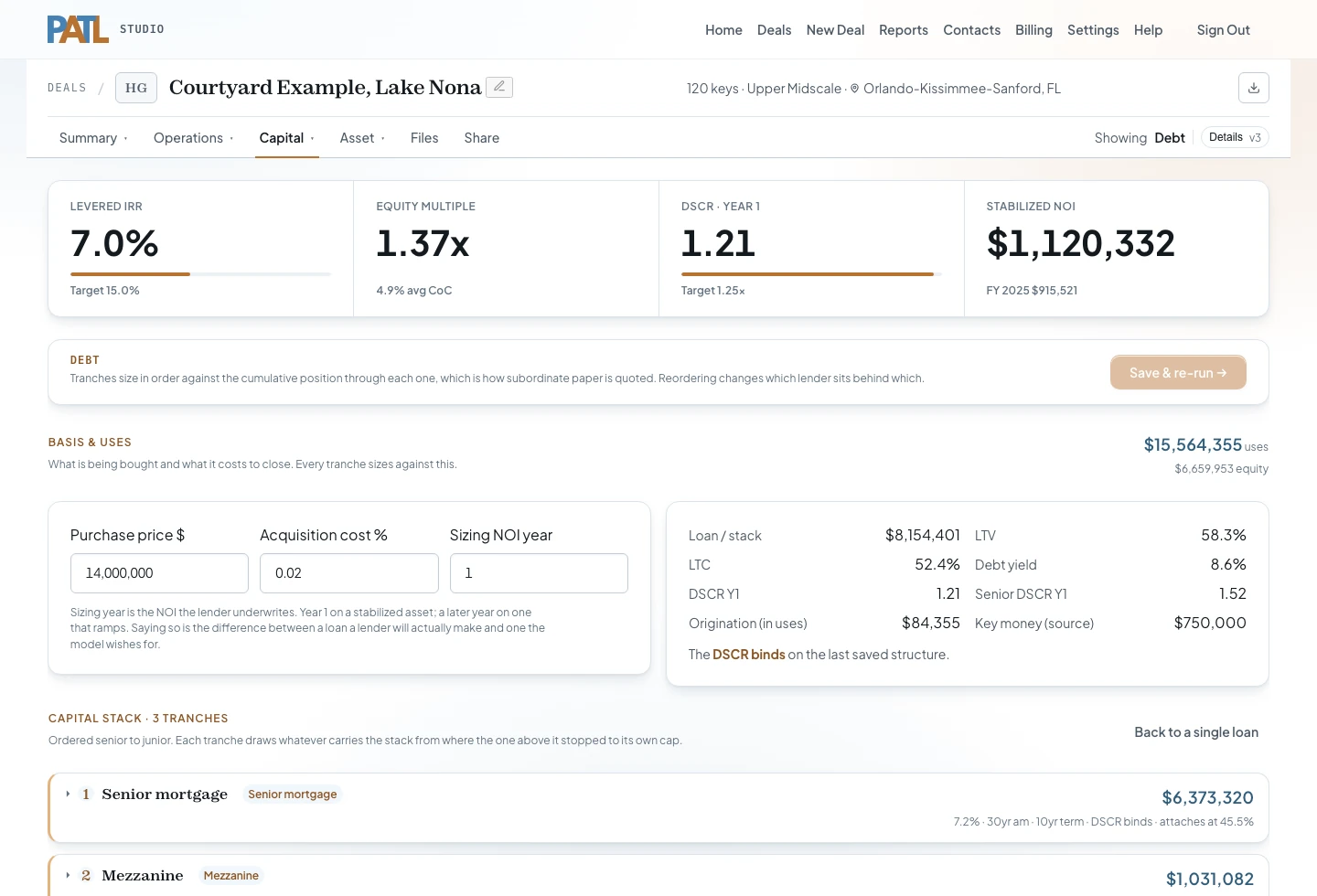
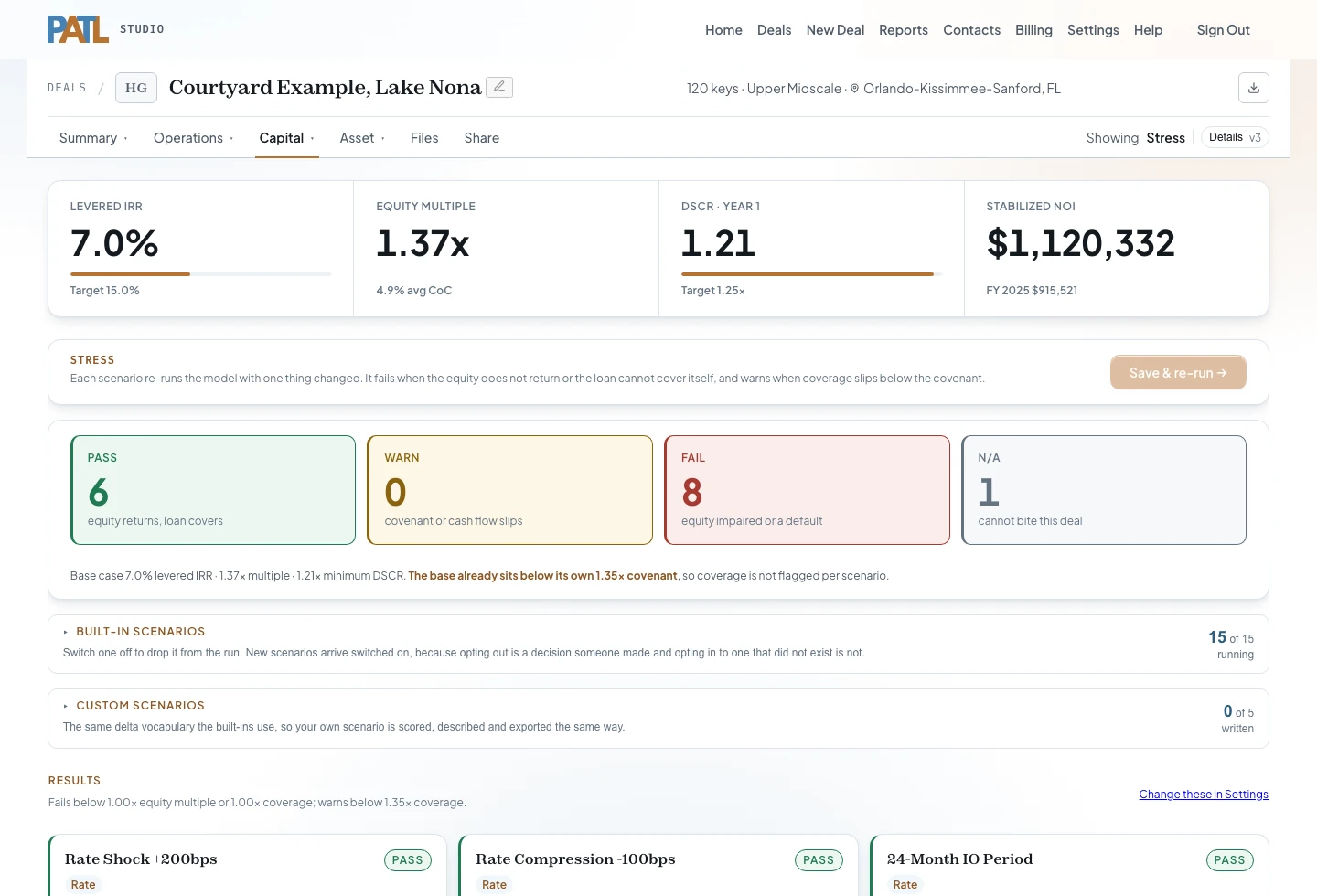
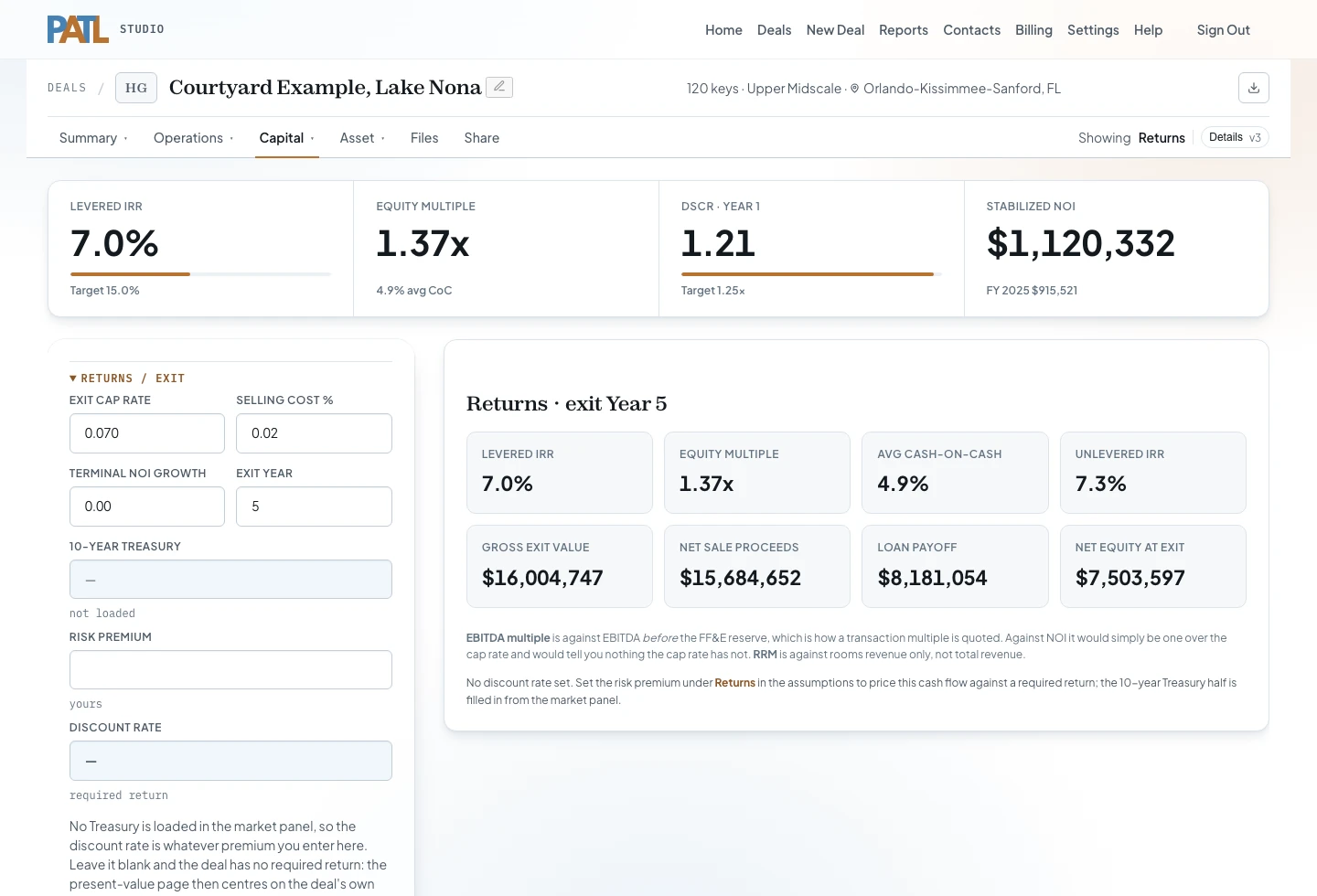
The actual workspace, not a mockup. Courtyard Example, Lake Nona — 120 keys, Orlando MSA. Every figure on it came out of the engine.
Why bother
Most of it goes into typing numbers out of a PDF and then checking whether they were typed correctly, which happens before anyone gets to the question of whether the deal is any good. Then the lender does it again, and the committee does it again, and asset management starts over at closing — six rebuilds of the same asset, none of which reconcile.
Today
With PATL
You still decide whether the deal is any good. You just get to that question a lot sooner.
The record
The run persists after the deal closes, which is the part a workbook cannot do. What changes between these four is who is reading, not what the numbers are.
Offering memorandum in, lender package out. Fifteen modules over one deterministic engine, every value traced to its source page.
Broker pipeline, proforma builder, data room and branded exports. The buyer receives a live workspace instead of an emailed PDF.
Memo generation, coverage tests rerun at the lender’s own rate, a version diff carrying the written justification for every override, and a diligence log.
Debt and insurance quotes requested from inside a model the lender already trusts.
Underwriting is where you start. The record is what you keep.
How it works
The model reads the offering memorandum and pulls keys, T-12 revenue and expense lines, ADR, occupancy and comp RevPAR. Every field comes back with the page it was found on and a confidence score.
Nothing reaches the model until you approve it. Each value sits beside its source page, so you can check a number against the document itself.
The engine builds RevPAR, runs the USALI departmental P&L, sizes debt against all three tests, and carries a ten-year cash flow through to IRR and equity multiple. Then you export a live Excel model and a branded PDF package.
Starting a deal
Pick the hotel out of the STR inventory or drop the offering memorandum in. The extraction, the staffing model and the market pull all run at once, and you can close the tab while they do — the deal is waiting when they finish.
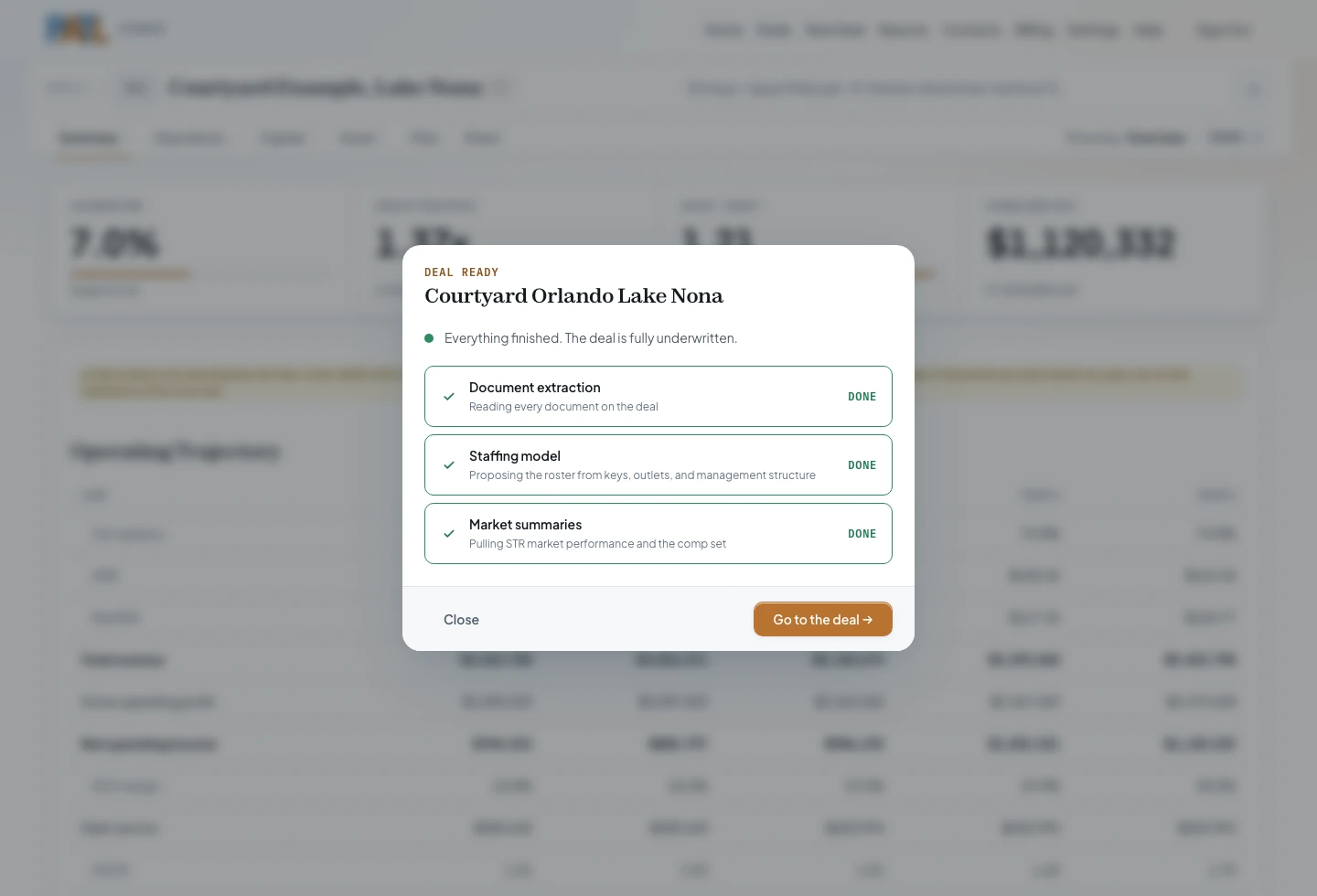
Language models are reliable at finding a number on page 14 and unreliable at arithmetic that has to tie out, so the reading is done by a model and everything downstream is computed by a deterministic engine in exact decimal, with no floating point anywhere in it. Running the same deal twice returns the same numbers, which matters because a proforma that moves between runs is not much use to a credit committee.
The engine
Every module below is hotel-specific, and each one is tested on its own.
Revenue
Occupancy ramp with month-level disruption windows, ADR growth, comp penetration index, and a seasonality curve you can pull straight from market data.
Channels
Each channel carries a share and a commission. The blended ADR drag falls out of the mix, and direct is the implied remainder, so the cost of distribution stays visible instead of sitting inside a net rate.
Departments
Rooms and other operated departments with their own direct expense, then A&G, sales & marketing, utilities, POM and IT to GOP, then fixed charges to EBITDA and NOI.
Costs
Every expense category runs as a single base rate or as a named build-up (percent, per-occupied-room, per-available-room or fixed) with its own escalation. You switch per category.
Brand
Royalty, brand marketing, reservation, loyalty and technology charges, each on its own basis. The output is the all-in brand load per year, which a single 5% royalty line hides.
Labor
Positions, counts and wages with a burden engine over them, allocated across departments, so a staffing change moves the P&L the way it moves the payroll.
Capital
The property improvement plan lands on the months you say it lands on, flows into uses and equity, and ongoing capex lands in the cash flow.
Debt
The loan is the minimum of the LTV, DSCR and debt-yield constraints, and the model reports which one binds. Interest-only and amortizing schedules with per-year coverage.
Returns
Exit at cap through selling costs and loan payoff to net equity, levered and unlevered IRR, equity multiple and cash-on-cash, plus two-axis sensitivity grids that re-size the loan in every cell.
Costs
Each USALI category runs as one base rate or opens into named line items, each on its own basis — percent of revenue, per occupied room, per available room, or fixed — with its own escalation. Switch a category open and the total is still the same number the P&L carries.
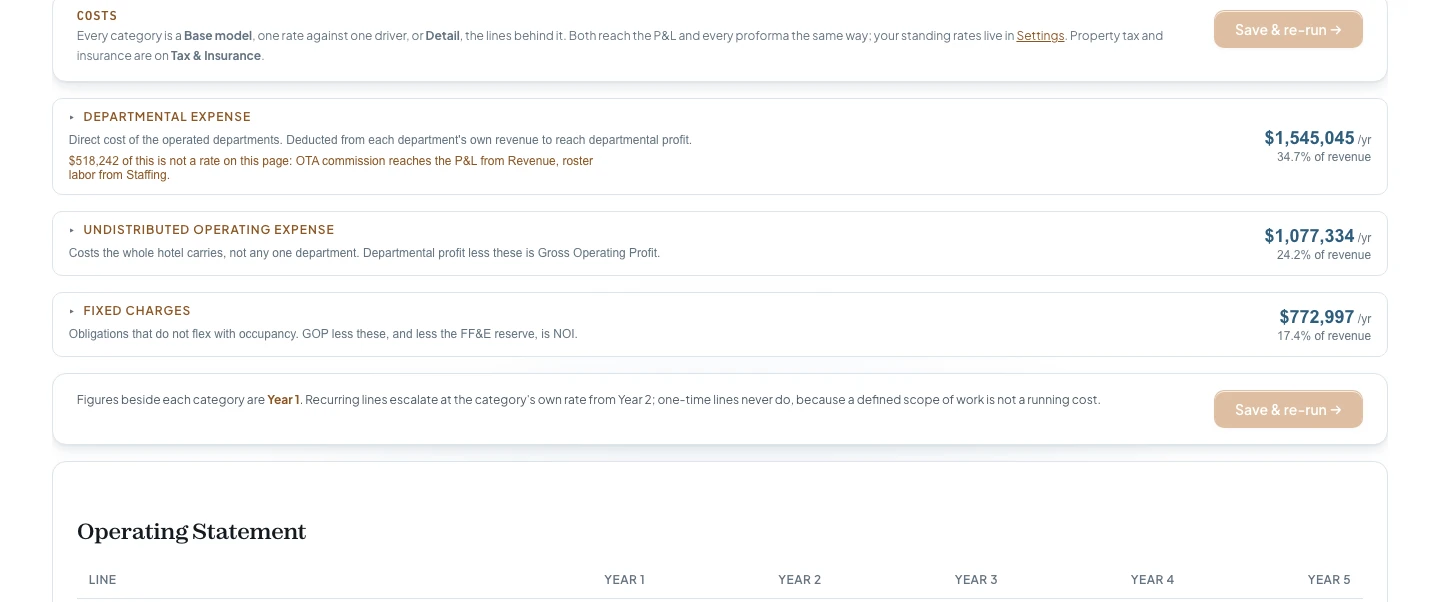
Costs · the departmental build-up
Debt
LTV, DSCR and debt yield each produce a number, the model takes the minimum, and it says out loud which one bound. When one loan is not the structure, the stack takes tranches senior to junior, each sizing against the cumulative position above it, which is how subordinate paper is actually quoted.
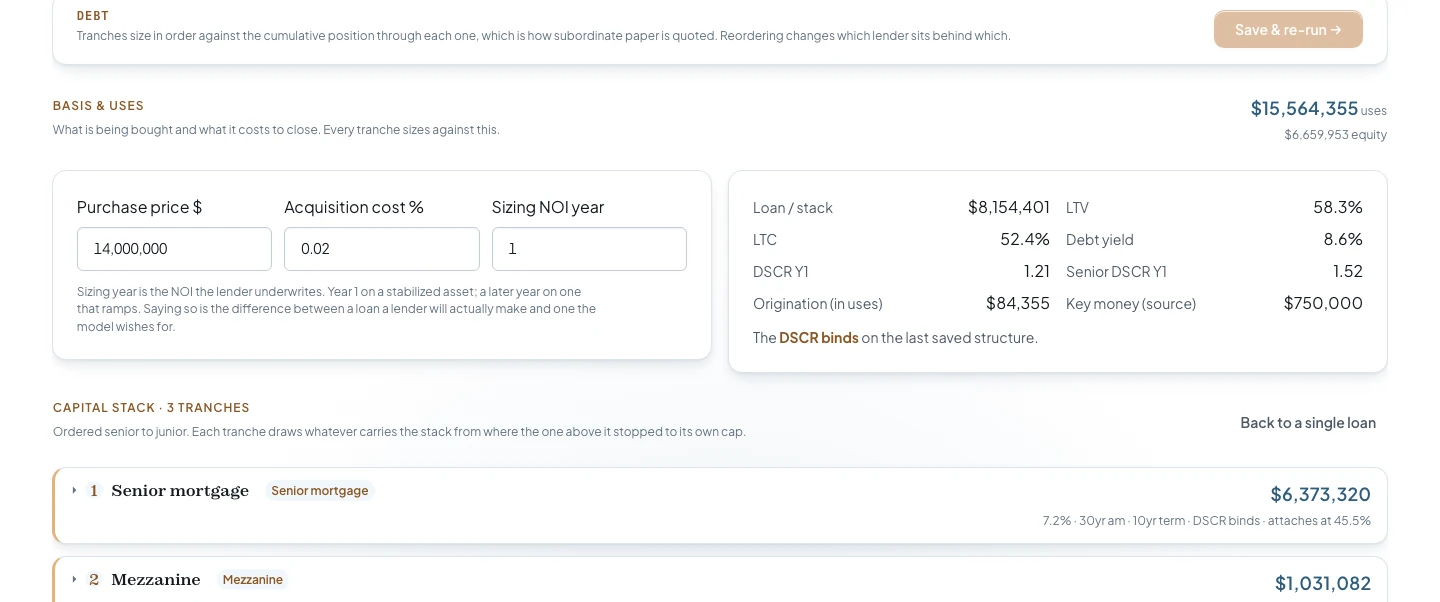
Debt · the sizing constraint that binds
Stress
Each scenario re-runs the whole model with one thing changed, then gets a verdict: it fails when the equity does not return or the loan cannot cover itself, and warns when coverage slips under the covenant. Write your own with the same vocabulary, and it is scored and exported the same way.
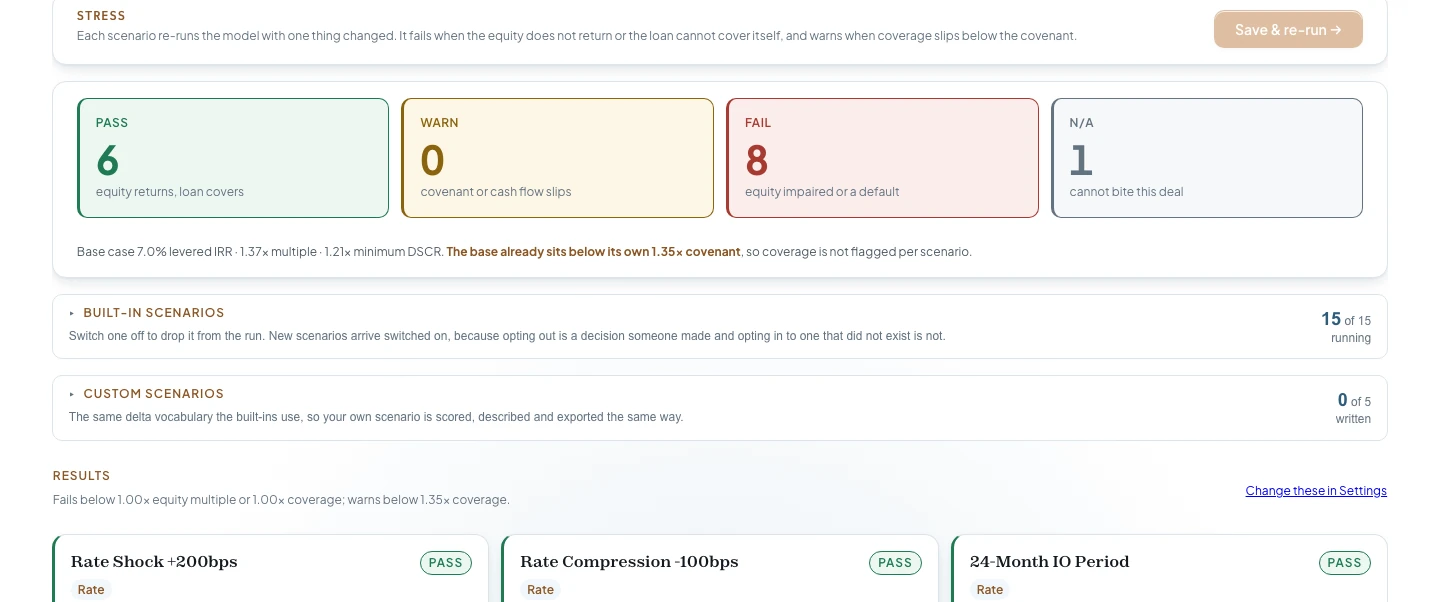
Stress · scenarios against the base case
Model Context Protocol
PATL ships a hosted MCP server. Point Claude at it and ask about your pipeline in plain language — it reads your deals, runs the engine and cites the figures, under your permissions and without a copy-paste.
The assistant decides what to ask. The engine decides what is true. No figure it reports is generated by a language model — the model calls a tool and the arithmetic is the same deterministic Python that produces your lender package.
What you get
Both exports are versioned, attached to the deal, and stamped with who generated them.
See one first
A 120-key select-service hotel: operating statement, KPIs by year, revenue and channel mix, staffing, capital plan, exit and debt, a stress grid that re-sizes the loan in every cell, and the monthly appendix. The figures are illustrative and there is no email form in front of it.
Every export is versioned per deal, so "which model did we send them in March" has an answer.
Who it is for
Pricing
Underwriting is unlimited at every tier. The meters are on exports and extractions, with 25 exports and 30 extractions included each month.
One live deal, one seat, the full engine and the PDF package. Excel export and additional deals need a paid plan, and there is no card required to start.
Proforma
one user, billed monthly, or $990 a year
Investor In build
per seat, billed monthly, or $490 per seat per year
Operator In build
unlimited seats, priced per hotel, storage facility or rental unit
Fund In build
unlimited seats, banded on assets under management
Asset mgmt Phase 4
add-on module, stacks on an Operator or Fund plan
Listing
broker OM publishing, one listing at a time
Proforma is live today, and annual is two months free at $990 a seat. Every other tier is in build, and the first 25 design partners get 40% for two years plus direct input on what gets modeled first.
What a customer actually pays
Roughly $150 per hotel per month. Argus Enterprise runs about $10,000 per seat per year before anything is modeled.
Full feature list
Free and Proforma carry the shared underwriting core. Operator and Enterprise/Fund add what a firm buying and holding assets does with it next.
| Feature | Free | Proforma | Operator | Enterprise / Fund |
|---|---|---|---|---|
| Deal Workspace | 1 Deal | ✓ | ✓ | ✓ |
| Pipeline | 1 Deal | ✓ | ✓ | ✓ |
| AI OM / Document Ingestion | 1 Deal | ✓ | ✓ | ✓ |
| AI Staffing Model | 1 Deal | ✓ | ✓ | ✓ |
| AI Deal Diagnostics | — | ✓ | ✓ | ✓ |
| Excel / PDF Deal Exports | — | ✓ | ✓ | ✓ |
| Reports Catalog | — | ✓ | ✓ | ✓ |
| AI — MCP Layer | — | +$39/mo | ✓ | ✓ |
| AI — Market Intelligence | — | +$99/mo | ✓ | ✓ |
| Portfolio Deals | — | — | ✓ | ✓ |
| LOI Generator | — | — | ✓ | ✓ |
| Portfolio Performance Analytics | — | — | +$75/asset/mo | ✓ |
| Asset Management | — | — | +$125/asset/mo | Add-on |
| Fund Builder | — | — | — | ✓ |
| Asset / Fund Data Room | — | — | — | Add-on |
Selling a hotel instead of buying one? See the broker-specific feature list →
Trust
It arrives under an NDA and it stays that way, with the isolation written into the database schema.
Every table is scoped to your organization and enforced by row-level security in Postgres, forced on at the database rather than by a WHERE clause somebody has to remember to write.
Uploaded OMs are cached per organization, so an identical document uploaded by another firm never touches your extraction, and yours never touches theirs.
The assumption set, the engine version and the timestamp are frozen on every run. You can always show which model produced which package, and when.
Every extracted field carries a data-rights class, so third-party licensed figures stay usable inside the app and stay out of your exports.
Questions
No. A model reads the PDF and proposes values, each one shown next to the page it came from. You approve or correct every one before it reaches the deal. From there the arithmetic is a deterministic engine, and the same inputs always produce the same outputs, to the cent.
You catch it at the review gate, which is exactly why the gate exists. Fields come back with a confidence score and a source page, so the ones worth double-checking announce themselves. Nothing is promoted into the model until you approve it.
Yes, and it is a working model. The P&L cascade ships as live formulas pointing at the assumption cells, so a lender can change a rate in the workbook and watch it recalculate.
There are three ways in: upload an OM, search 261,000 US lodging records and seed the deal from the property record, or type the assumptions yourself.
Yes. download the sample investor packet. Twenty pages generated by the engine from a sample 120-key select-service deal, with the figures marked illustrative. There is no email form in front of it.
No, and every package says so on its face. It is an underwriting model that shows its work: assumptions, sources and engine version.
One live deal, one seat, the whole engine and the PDF package. Excel export and additional deals are the line between Sandbox and a paid plan. There is no trial clock, since Sandbox does not expire.
Hotels first, because operating assets are where a lease-based model breaks down and hotels are the hardest version of that problem. Self storage and short-term rental run on the same engine and are priced on the same card.
Get started
The scanned one, with the T-12 as an image and the expense detail in a footnote, is the one worth testing this on.